2025.Dec.23
EVENTSConcluding symposium of the Trauma Reporting Study Group
“Towards Practicing Trauma-Informed Journalism” (February 14, 2026)
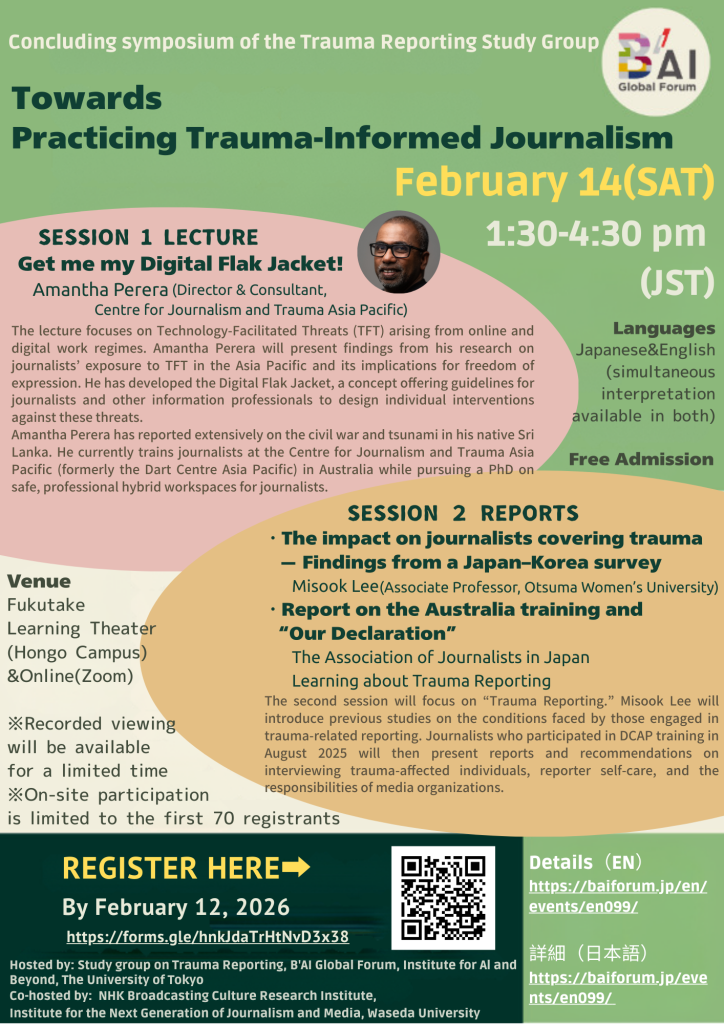
The B’AI Global Forum will hold the concluding symposium of the Trauma Reporting Study Group “Towards Practicing Trauma-Informed Journalism” on February 14(SAT), 2026. We warmly invite you to join us.
◇Date & Venue
・Date: February 14 (SAT), 2026, 1:30~4:30 pm (JST)
・Venue: Fukutake Learning Theater (Hongo Campus) and Online(Zoom)
※On-site participation is limited to the first 70 registrants.
※Recorded viewing will be available for a limited time.
・Languages: Japanese and English (simultaneous interpretation available in both)
・Admission: Free
・How to register: Pre-registration is required via the link below by February 12.
https://forms.gle/hnkJdaTrHtNvD3x38
※The URL for online participation will be sent on February 13, the day before the event.
◇Program
<Session 1: Lecture>
・Get me my Digital Flak Jacket!
by Amantha Perera (Director & Consultant, Centre for Journalism and Trauma Asia Pacific)
In his home country of Sri Lanka, Amantha Perera worked as a journalist covering the civil war and natural disasters such as the 2004 tsunami, contributing to TIME, Reuters, and Al Jazeera.
He is currently based in Melbourne, Australia, serving as Director and Consultant at the Centre for Journalism and Trauma Asia Pacific (formerly the Dart Centre Asia Pacific, renamed in November 2025), where he provides training on trauma-informed reporting for journalists across the Asia-Pacific region (https://journalismandtrauma.org/). He is also pursuing a doctoral degree at Adelaide University, researching safe and professional hybrid workspaces for information specialists, and has developed a new concept titled “the Digital Flak Jacket” to enhance safe and professional hybrid workspace for journalists.
New Research
• How the COVID-19 lockdowns influenced journalists to change the way they react to online and digitally enhanced dangerous and fake content
• “Am I Failing to Protect Them?” The Impact of Abuse (of Journalists) on Newsroom Leaders in the Asia Pacific
Abstract
Amantha Perera will speak on emerging threats arising from exposure to online and digital work regimes, referred to as Technology-Facilitated Threats (TFT)and potential countermeasures. As our reliance on online and digital information grows, we are increasingly exposed harmful interactions in hybrid workspace: disasters are witnessed through smartphone and computer screens, and journalists have become more vulnerable to online attacks. In this lecture, he will expand on the threats faced by journalists in Asia Pacific and examine their impact on journalism and freedom of expression. He will also introduce a new concept to tackle TFT. Titled the Digital Flak Jacket, it provides guidelines for journalists and other information professionals to develop individual interventions to pushback against TFT.
<Session 2: Reports>
・The impact on journalists covering trauma — Findings from a Japan–Korea survey
by Misook Lee (Associate Professor, Otsuma Women’s University)
・Report on the Australia training and “Our Declaration”
by The Association of Journalists in Japan Learning about Trauma Reporting
Journalists, researchers, and human rights activists from diverse backgrounds engage with people who have experienced trauma—deep psychological wounds—listening to their stories and sharing them with society. In trauma reporting, it is essential to set aside assumptions and truly “understand the trauma of those interviewed.” Moreover, to ensure safer and more sustainable practice, it is also necessary to “recognize and prepare for the impact on the reporters themselves” and “care for colleagues and peers.”
In Australia, a civil lawsuit filed by a journalist who developed PTSD after prolonged harsh reporting resulted in a victory for the journalist in 2019. The court criticized not only the newspaper’s inadequate response but also the lack of training on trauma among most managers and insufficient education for younger reporters regarding risks and coping strategies, highlighting the absence of preventive measures.
These issues—journalism, trauma, and resilience—will be addressed in reports by journalists from newspapers, broadcasters, and news agencies, as well as researchers, who studied at the Dart Centre Asia Pacific in Melbourne in August 2025. Thirteen members of the “Japanese Journalists Learning Trauma Reporting Group,” which grew out of the Trauma Reporting Study Group, participated in an intensive four-day training. They will share what they learned and present “Our Declaration” outlining future actions.
In addition,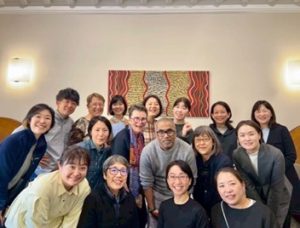 findings on the impact of covering trauma on journalists will be presented. In Korea, the Women Journalists Association conducted the first nationwide survey on “Journalists and Trauma” in 2021. Insights from this survey, together with findings from Japan, will be presented, followed by a discussion of future challenges.
The Trauma Reporting Study Group, after five years of activity, is scheduled to conclude at the end of this fiscal year.
(Photo: August 8, 2025, Melbourne, provided by the Japanese Journalists Learning Trauma Reporting Group)
◇Organizer
Study group on Trauma Reporting, B’AI Global Forum, Institute for AI and Beyond, The University of Tokyo
◇Co-organizer
NHK Broadcasting Culture Research Institute
Institute for the Next Generation of Journalism and Media, Waseda University
◇Inquiry
B’AI Global Forum Office
bai.global.forum[at]gmail.com(Please change [at] to @)
 BACK
BACK NEXT
NEXT