2026.Mar.16
REPORTSTrauma Reporting Study Group Symposium Report:
“Toward Trauma‑Informed Journalism Practice”
Michiko Kawahara (Project Professor, Interfaculty Initiative in Information Studies, The University of Tokyo)
Translated by Minjoo Lee (Project Assistant Professor, Interfaculty Initiative in Information Studies, The University of Tokyo)
•Date: February 14 (SAT), 2026, 1:30~4:30 pm (JST)
•Venue: Fukutake Learning Theater (Hongo Campus) and Online (Zoom Webinar)
•Languages: Japanese and English (simultaneous interpretation available in both)
• Moderator: Michiko Kawahara (Project Professor, Interfaculty Initiative in Information Studies, The University of Tokyo)
• Opening Remarks: Ai Hisano (Associate Professor, Interfaculty Initiative in Information Studies, The University of Tokyo; Director, B’AI Global Forum)
(Click here for event details)
On 14 February 2026, the Trauma Reporting Research Group held a symposium titled “Toward Trauma‑Informed Journalism Practice” to mark the culmination of its five years of activities. The event was streamed as a webinar, with limited-time on‑demand viewing made available afterward.
Coverage of the symposium appeared in the following media outlets:
• “How Should Journalists Approach Trauma Reporting? Symposium in Tokyo Highlights the Need to Understand and Respect Survivors, and to Protect Reporters Themselves,” Shimbun Akahata, 17 February 2026, p.10 (Tokyo Metropolitan Edition)
• “Toward Better Disaster and Incident Reporting Through Trauma‑Informed Practice: Journalists Convene for Symposium / ‘Digital Flak Jacket’ Against Online Abuse,” Weekly Kinyobi, 27 February 2026, p.8
• “Reflecting on Reporting Practices Involving Trauma: Symposium at the University of Tokyo Emphasizes Recognizing the Risks Reporters Face,” Japan Newspaper Publishers & Editors Association Bulletin, 10 March 2026, p.3
The symposium consisted of two parts: Part I, a keynote lecture, and Part II, a series of reports.
In Part I, Amantha Perera—Ph.D. candidate at Adelaide University and Director and Consultant at the Centre for Journalism and Trauma (CJT, formerly the Dart Centre Asia Pacific) in Australia—delivered a lecture titled “Get me my Digital Flak Jacket!” Perera has worked as a newspaper reporter and freelance journalist in his home country of Sri Lanka, covering the civil war and the devastation caused by the 2004 tsunami, contributing to outlets such as TIME magazine and the Guardian. He is currently pursuing a doctoral degree at Adelaide University, where he is researching the development of safe and professional hybrid workspaces for information professionals.
His commitment to examining trauma- informed journalism, as well as the safety of journalists, was shaped by a deeply personal turning point: the killing of his editor who he greatly admired. Struggling to contain his own anger, he sought ways to understand his reactions and eventually sought help from the former Dart Centre, which had been providing awareness and skills on trauma and journalism. At the conclusion of Part I, participants at the venue observed a moment of silence in memory of his late editor and other journalists around the world who have lost their lives in the line of duty.
Summary of the lecture
It has become increasingly difficult for journalists to work—or even maintain personal relationships—without smartphones and other digital devices, to the point that many now keep their phones at their bedside. In an environment where complete disconnection from the digital sphere is no longer feasible, we are continually exposed to technology facilitated threats (TFTs). These threats arise not only during information gathering, processing, and dissemination but also through interactions with readers and audiences.
Such threats take two forms. The first are explicit threats, which involve a clear intent to harm, and the second are ambiguous threats, which may cause distress despite lacking malicious intent, such as graphic footage sent from conflict zones. Both types can have significant psychological impact. Research increasingly shows that online and hybrid threats can be just as harmful as offline ones. Exposure to traumatic content and impact can erode a person’s capacity to express themselves, and when journalists lose their voice, the consequences can be far‑reaching.
As these “technology facilitated threats” continue to grow, developing the skills to recognize and understand them has become essential. This is the context in which I propose the concept of a “Digital Flak Jacket”—a simple framework designed to help not only journalists but other information professionals work more safely and sustainably in digital and hybrid work environments.
The “Digital Flak Jacket” encourages individuals to analyze the TFTs they face by applying the 5W1H framework, enabling them to identify and assess their specific risks.
<The 5W1H Framework>
W1: Where
On which platform did the threat occur? For example, was it on Facebook, in a chat group, or elsewhere?
W2: On what
Through which device did the threat reach you—your smartphone, your computer, or another device?
W3: When and where
When and where did it happen? Was it a one‑time incident or ongoing? Were you on duty
or off duty? At home or working elsewhere? Does the threat tend to occur in specific locations?
W4: Why
Why were you exposed to the content? Were you viewing it for work, for personal reasons, out of curiosity, or simply out of habit?
W5: Who
Who was with you at the time? Were you alone, with colleagues or family members, or surrounded by strangers?
H1: How
Finally, reflect on what you can control and how you can exercise that control.
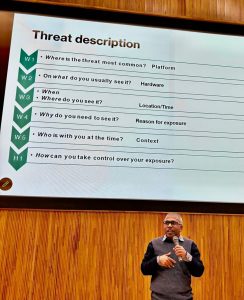
Perera encouraged participants to recall a specific threat they had encountered and to write out the 5W1H for that incident. The countermeasures do not need to be elaborate—simple, self‑directed actions are sufficient. For example, blocking the perpetrator may be enough. In his own case, when a digitally manipulated image of him was circulated on Facebook for commercial purposes, he contacted Facebook staff directly and had it removed when the platform’s machine reliant moderation mechanism failed.
The “Digital Flak Jacket” is most effective when built upon balanced and mindful engagement with digital and online spaces. This includes maintaining as clear a boundary as possible between personal and professional use, taking regular breaks, and being mindful of one’s well‑being. Because enclosed spaces can increase immersion and stress, Perera noted that those who work with their screens facing a wall may benefit from rearranging their workspace so that their field of view opens onto a broader environment.
He concluded by encouraging participants to identify practical, applicable steps they can take to protect themselves in their own digital work environments.
Part II – Report 1: “The impact on journalists covering trauma — Findings from a Japan–Korea survey”
Part II began with a presentation by Associate Professor Lee Misook (Otsuma Women’s University) titled “The impact on journalists covering trauma — Findings from a Japan–Korea survey.”
Lee explained that discussions on trauma and journalists first emerged in the English‑speaking world in relation to Vietnam War correspondents, who exhibited symptoms such as dissociation and substance use. By the 1990s, these issues came to be understood as structural problems inherent in the profession. At the same time, however, a professional culture persisted that insisted journalists “should be tough,” discouraging acknowledgment of psychological impact. In reality, many journalists and photojournalists routinely encounter scenes of catastrophe and individuals who have experienced trauma, leaving them vulnerable to feelings of helplessness and self‑blame.
Lee began by clarifying the significance of trauma‑informed journalism. She emphasized that it is not only an ethical responsibility toward trauma survivors, but also essential for journalists’ own well‑being and ability to function as healthy professionals. When survivors feel safer and more respected in the interview process, reporting can yield deeper insight and greater empathy. This, in turn, supports meaningful civic engagement, contributes to institutional reform, and strengthens survivors’ resilience.
Drawing on previous research, Lee highlighted several key findings regarding the harm journalists experience:
1. Early intervention is crucial.
2. Moral injury—the distress that arises when one’s moral beliefs or ethical values are profoundly violated, or when one is unable to act in accordance with what one believes is right—has a significant impact on journalists’ sense of identity and existential well‑being.
3. Journalists who have received education on trauma or training in trauma‑informed reporting show greater potential for post‑traumatic growth.
4. Lack of organizational support contributes to worsening symptoms.
5. Incidents of online harassment are increasing worldwide.
In the 21st century, surveys conducted in both Japan and South Korea have further illuminated the stress reactions, feelings of helplessness, and concerns about possibly having harmed interviewees experienced by journalists covering traumatic events. In a recent South Korean study, 80 percent of respondents answered “no” when asked whether they had received appropriate training prior to engaging in trauma reporting. While gender differences were generally minimal, one clear exception emerged: in cases involving coverage of sexual violence, women were more than twice as likely as men to indicate in the survey that they had experienced trauma‑related events connected to their reporting.
Earlier surveys in Japan showed that over 90 percent of respondents were male. Given the significant changes in the information environment since then, Lee noted that she is planning a new study to examine the realities of traumatic experiences among journalists in Japan in the digital age.
Part II – Report 2: Report on the Australia training and “Our Declaration”
In the second report, Aya Shioiri (The Asahi Shimbun) and Miki Kato (The Chunichi Shimbun)—members of the “Association of Journalists in Japan Learning about Trauma Reporting” —presented an overview of the training they attended in Australia in August 2025 at the Dart Centre Asia Pacific (renamed the Centre for Journalism and Trauma in November 2025). Following their presentation, Naoko Sato (The Tokyo Shimbun), Midori Kawamura (Jiji Press), and Akiko Minatoya (Jiji Press) reported on the group’s post‑training initiatives and introduced “Our Declaration.”
The four‑day program covered a wide range of practical topics, including online harassment, interviewing trauma survivors, moral injury, and peer support. Shioiri noted that the training was impactful not only for its lectures but also for its experiential components. These included paired role‑plays of “good interviews” and “poor interviews,” which allowed participants to step into the emotional perspective of interviewees. Each participant also delivered a presentation on a personally meaningful reporting experience, helping them appreciate the importance of being heard in a safe, non‑judgmental environment.
Kato later wrote about the training in a two‑part feature column for the Chunichi Shimbun (Chunichi Shimbun, morning edition of 21 December 2025, “Reflecting on Trauma Reporting, Part I: Must Journalists Be ‘Tough’?”; and morning edition of 28 December 2025, “Reflecting on Trauma Reporting, Part II: Reporting Without Harming, Without Being Harmed.”). She had anticipated criticism, believing that journalists were not supposed to speak about their own distress—especially when survivors themselves endure far greater suffering. Instead, she received messages from readers expressing sentiments such as, “It is precisely because journalists are not invulnerable that they can notice, empathize with, and imagine the experiences of those in vulnerable positions.” Fellow journalists also responded, saying, “I, too, felt unable to speak about this,” and “This kind of training is urgently needed.”
Kato also explained a concept introduced during the training: “Put the power in the middle.” Because trauma inherently strips individuals of power, trauma‑informed reporting requires placing power—meaning agency and decision‑making—between the journalist and the interviewee. This involves, for example, discussing together where the interview should take place or whether breaks are needed, and proceeding in a way that respects the interviewee’s preferences. She shared the story of a bereaved family member who had once been interviewed by a young reporter. The reporter admitted it was his first time conducting an interview with a grieving family. Because of this openness, the interviewee felt able to express her wish not to be photographed while crying, and the two of them worked out how to proceed. She later said she was grateful to have been listened to, and that this experience shaped her approach to future interactions with the media.
In the latter half of the session, members reported on how they had begun sharing what they learned after returning to Japan, including conducting role‑plays within their newsrooms. The group then discussed what commitments they should carry forward as journalists trained in trauma‑informed practice. The principles they collectively formulated were presented as “Our Declaration” by Sato, Kawamura, and Minatoya.
<Our Declaration>
For the sake of better journalism, we commit to the following principles in trauma reporting:
1. We strive to engage with interviewees on an equal footing.
2. We make efforts to follow up after interviews.
3. We value self‑care.
4. We support one another as colleagues.
5. We work to expand the community of people who understand and value trauma‑informed reporting.
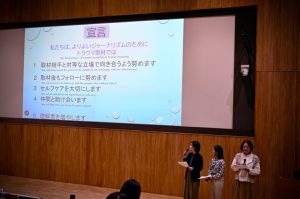
The presenters elaborated on each of these points. The final principle—“We work to expand the community of people who understand and value trauma‑informed reporting”—includes commitments such as: continuing to share the importance of trauma‑informed reporting with colleagues and supervisors; building connections beyond the media industry; and, in the long term, contributing to changes in reporting practices and journalistic culture.
At the end of Part II, Michiko Kawahara, Chair of the Trauma Reporting Study Group, delivered closing remarks titled “As We Bring the Trauma Reporting Study Group to a Close.” In her remarks, she expressed her commitment to helping transform journalistic culture into one that is more humane and compassionate through the kinds of practices discussed today.
 BACK
BACK NEXT
NEXT